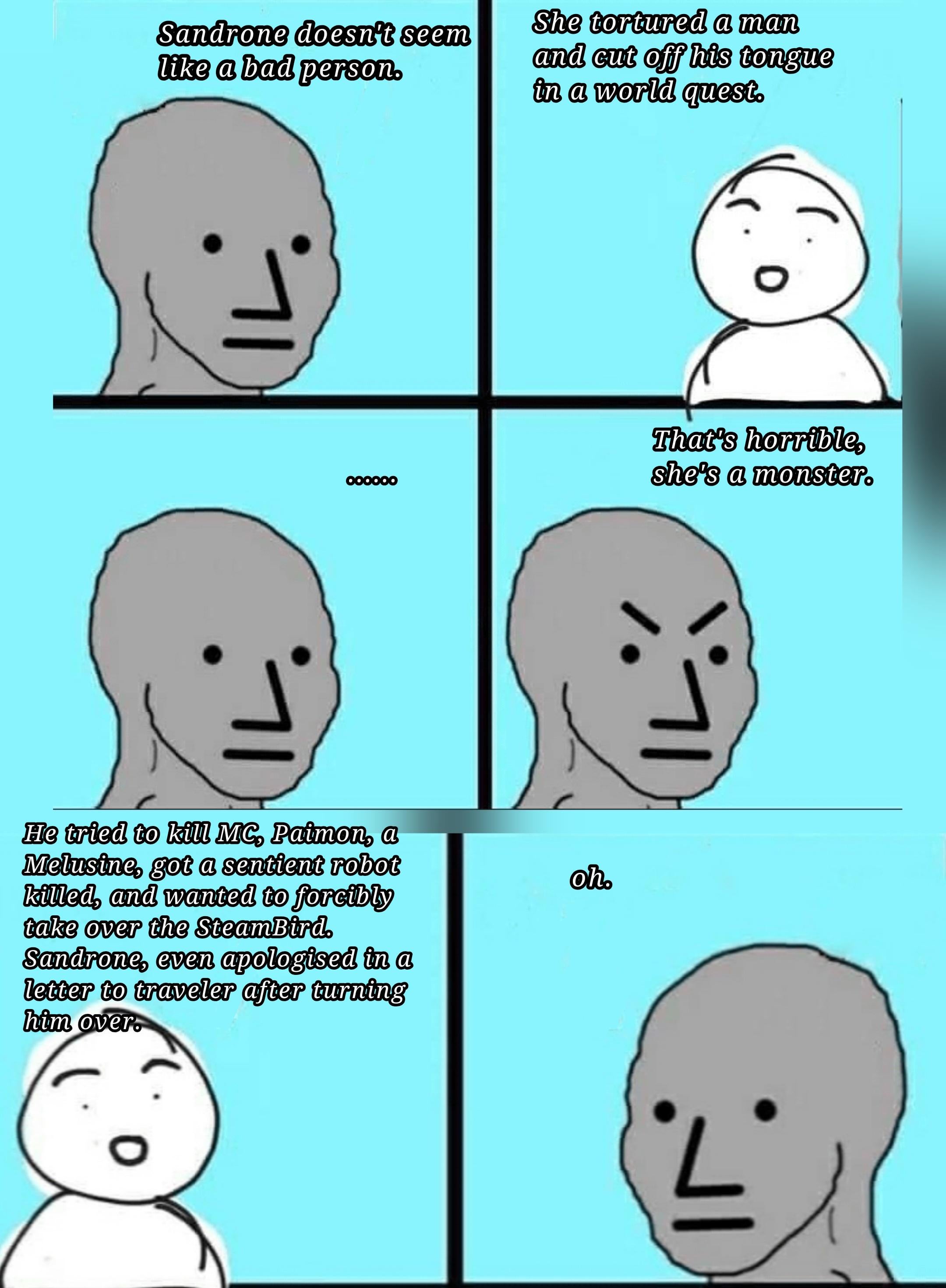
Bad person does bad thing to bad person.
Not condoning Sandrone's actions. She's still a fatui harbinger, who tried to infiltrate Natlan, and is working alongside other villains like Childe who tried to drown Liyue, Signora who caused a civil war in Inazuma, Arlecchino who runs an orphanage of child soldiers >!though they can leave if they want, with no consequences.!<
Valid criticism can be pointed at the writing for the traveler for not properly confronting these characters on their actions, but argument can be made on the traveler's morality. But it's invalid to say, that these characters are "redeemed" rather, they are not morality black and white. Hoyo has a patten of writing gray morals when dealing with characters with large complex roles in the story, while smaller characters are sometimes written black and white.
Reminder in the last act of Natlan, Sandrone tried to kidnapped Ineffa. But beyond that, we don't know, what she wanted with her, or how she would have treated her if she succeeded. Even the fatui involved, who were working under her orders, were also written with gray morals, with them apologising for the spy's wife getting hurt. Basically what I'm saying is, people need to analyse the characters and writing as a whole before making grand sweeping statements like Hoyo is redeeming villains, or the traveler is a hypocrite hero.
Jenck, the character who got his tongue cut: https://genshin-impact.fandom.com/wiki/Jenck
The world quest in question: https://genshin-impact.fandom.com/wiki/Questioning_Melusine_and_Answering_Machine
Commentaires
>Sandrone tried to kidnapped Ineffa. But beyond that, we don't know, what she wanted with her, or how she would have treated her if she succeeded.
given how she treats Pulonia that she's basically doing maintenance service round the clock, i'm pretty sure Ineffa will be treated fairly
>people need to analyse the characters and writing as a whole before making grand sweeping statements like Hoyo is redeeming villains, or the traveler is a hypocrite hero.
i agree. i really admire that she went out of her way to:
1. write an apology letter because one of minions missions went off script
2. punished said minion with ***EXTREME*** prejudice.
3. welcomed us to Nod Krai (despite the accompanying threat to just not disturb what she's doing)
4. complied with traveler's request to contact Arle to help.
5. helped us against Rerir without us asking.
6. joined the festival to bid farewell without us asking.
7. drew in the picture book/farewell letter.
8. casually discussing WQ with us out of the blue without us poking at the topic
9. looks like she'll be helping more with Dottore
10. made Pulonia look Anemo
#i'm definitely pulling no matter what.
#poorly disguised threads so we can actualy talk about lore for once
Why they can’t admit, yeah he/she is a piece of shit but I like his/ her character
Having a character that's gray on paper but the story mostly focuses on the white part, doesn't really make them all that gray.
Like, not to talk about other games, but...I recently played Duet Night Abyss and the grey characters there are pretty interesting.
It feels like that the people writing the world quests and making the lore of Genshin in artefact sets, weapons and in game books are a different team than the people writing the archon quest and character story quests. Or maybe they are given different degrees of freedom. I think the best way to describe how I feel about the game is that it has really fascinating lore that is let down by weak moment to moment story beats and bad characterisation choices.
Your point of editors intervening to make changes to would also help explain some of these strange choices.
Bc their kink is the moral high ground, always, all of the time. It's where they get their sexy fun times from.
Vegeta was blowing up entire civilizations before coming to Earth, never faced any consequences, and then became buds with Goku
The first time he died painfully after Frieza tortured him, then was resurrected as part of the wish to bring back Frieza's victims.
The second time is when Vegeta was properly punished and was sent to hell, despite his attempt to sacrifice himself and kill Buu.
Even Kid Buu was brought back as the villager child Uub, after King Yenma heard Goku's wish to see him again.
The way Toriyama handles good and evil reminds me of the process of "karmic purification".
The souls in DBZ get purified and eventually get reincarnated back into the cycle of life.
Then entire thing with King Enma and the ledger of death are also in the Wukong myth, so they are referencing real life religions, but I'm not too knowledgeable on the details.
Meanwhile with Sandrone, "oh she might be mean from the outside but she is still such a sweetie from the inside!" Blah blah. Hoyo is trying really hard to whitewash her lol.
Arlecchino also tried to kill Furina and she grooms children but its been never bought up
Sandrone just cut tongue of guy who try to kill him/her, and do threats she never really do.
Arlecchino tried to kill Furina because she thought she was an uncorcerned god who don't do anything, not an incapable human begin, when she learn it she never do it again. Plus she grooms childrens because if she don't fatui gonna take her into jail and put someone else will do it, maybe worse person.
Arlecchino literally tried to assassinate Furina. Don't try to make it better
They are both bad people but only one is shown as such
>quoted from the link "implied to be [Sandrone](https://genshin-impact.fandom.com/wiki/Sandrone)"
You're jumping to conclusions. There’s a significant difference between a vague suspicion and a narrative implication. Without concrete evidence linking her to the act, calling it 'implied' is just speculation.
OP is just arguing that even if it *was* Sandrone, Jenck was hardly an innocent civilian, and while his punishment was extreme he did murder a sentient Robot and attempted to murder three people. I've seen plenty of comments where Sandrone's [alleged] actions are presented with no mention of how Jenck was a right bastard
Jeht turns the guy recieving her as a captive into confeti, tried to kill the traveler (just because someone *told* her the traveler betrayed her), and slaughtered an entire tribe to make Babel suffer before she killed her. - glorified as a hero
She slaughtered the entire tribe because the entire tribe insisted on standing between her and Babel, even after Babel's crimes were made public.
They are supposed to just let someone, who's well known for catching and killing the people of their tribe already, just waltz in, wreck the place, and kill their leader going off nothing but their words? This is Jeht making these accusations, the same girl who makes gut feeling conclusions and doesn't fact check. In the same quest she was even going after Traveler's head because they also "betrayed" her, or so she was told.
Jeht pretty clearly established herself as a threat. You have to literally approach Yuften, the autistic-coded crocodile caretaker who is pleading for Jeht to just stop. She never shows remorse for the lives she took, only the fact that Babel had the gall to betray her. Jeht even gloats in her victory.
\---
I really hated that last quest because they just flanderized everyone.
Babel as a stupid evil maniac
Jeht as an unhinged massacrer
and Traveler as a useless bystander to all the violence
Ah, the nuance!
Nefer manipulated TWO tribes to wipe each other out in vengeance for her father.
It's obvious they want to keep a fairly light tone while also explore more mature topics. It might or might not be because they're a gacha company, but I mean, HSR has characters that have done worse.
Although what she did with Sara and Echo was definitely just a dick move.
It would be a dick move if she injured her on purpose.
Echo one was a dick move though, she fixed 1 problem and gave him a bigger one.
Framing.
Literally. The reason why Arlecchino and Sandrone are never questioned for their dubious bullshit or why it feels like it’s swept aside to some is because the game just doesn’t frame it that way. Hell, Sandrone using Colonizer language and being okay with wiping out the Frostmoon Scions is arguably a bigger issue than killing a subordinate yet it’s not brought up because it’s never brought up again by the game showing that we should not take that event as important.
Alice‘s crimes against nature isn’t being seen as bad by the fanbase and the game itself because it isn’t framed that way. It’s quirky, wild, and funny. Which the game heavily leans into because they want you to like, and eventually, pull for this woman
The writing in this game is never subtle who you should and shouldn’t care about. ESPECIALLY about playable characters. People look for nuance when the writing does its job at alluding to complex moral relationships without ACTUALLY having to write for it because the fans fill in the blanks already themselves. Keeps discussion going, keeps engagement.
I don’t think you can colonize your own territory. It’s more like they’ve left them alone all this while.
Thanks for reminding me which it was!
Don’t get me wrong, I’m not criticizing Sandrone as a character for this. We could use more non-hostile characters that are either morally questionable, or just outright sadistic.
Jokes aside, that's a lot of effort to defend...check notes...an anime waifu.
But at the end of the day, she is still one of the leading reasons that the Fatui runs an oppressive stronghold in Nod Krai, and has troubled many of the local citizens. It's all a matter of perspective, and anyone trying to dismiss a character just because they don't fit nicely into "good guy" and "bad guy" boxes doesn't truly understand how 'people' and interpersonal relationships work. Sure, these may all be fictional characters, and there's obvously dramaticization involved, but the way these grey areas and fine lines are drawn is relatively realistic to a degree.
Either way I’m so ready for Sandrone’s badass moment, they’re finally letting her shine🫂
They'll argue that a character didn't do anything to "earn their redemption" while simultaneously raging when said character is given the space or freedom needed to do that in the first place.
which is the best part about her she is just cool af which weights a lot more
the community is divided into people who make all characters one-dimensional and mischaracterise them to hell, and the people who actually look at all the facets of a character usually keep to themselves or stay in the lore discussion areas 😭
The 11th dragonlord
Also the traveller really isn't a paragon and is very willing to kill people if they hurt people he cares about(see the jeht questline and optionally the aranara questline) and depending on your choice in the leroy questline they also might not be opposed to vigelante justice so traveller not trying to confront her about this isn't really out of character, can't exactly blame anyone for not knowing though as all of the non paragon behaviour the traveller shows is just in world quests so 99% of the playerbase doesn't know.
We have three playable harbingers who have killed many people. Things are complex, deal with it.
Honestly tho in this social media Tiktokky, whatever, landscape, that does feel kind of impossible. You'll get those snowballing Twitter threads that castigate any grey character or a hashtag on tiktok about #charactervillain. And then of course Buzzfeed or Huffpo, or these days even prestige outlets, will run a piece on what The People on X Are Saying. Suddenly studios and actors are getting death threats and major media journalists are doing pieces about how awful a certain character is and how dangerous it is to romanticise or like that character.
I have way more sympathy for writers who simply cave because it's too exhausting and not worth it.
The internet will explode.
Slay, queen.
personally,I'd pick sandrone just cause she cute
We're gonna kill him only to get to Snezhnaya and find a mint condition still in box spare Dottore segment that he just had lying around for reasons. This Dottore segment will be our playable Dottore with the argument being that since Dottore Prime made this fool and then put him into storage immediately, that means that **THIS** Dottore specifically hasn't actually done anything wrong and we can be buddies.
Traveler can't go around and fight everyone, especially fighting those in grey line like Arle and Sandrone would bring more harm than good.
According to wiki, she didn't order that.
>At some point, Velimiru's group took it upon themselves to impress Sandrone by going on a reconnaissance mission to Natlan in order to extract the vast knowledge possessed by the dragons. Upon trying to gain approval from Sandrone for this mission, Sandrone warned them that it's a dangerous one, especially as they might encounter the Traveler, who she called an unpredictable variable, but she also didn't completely disapprove should they choose to go on this mission
2 wrongs dont make a right. Its obviously implied Sandrone does this to dozens of other goons without caring about their background
Here is another thing to consider. At this point the Traveler is one of the most important people in the entire world. From the connections with gods and god like beings they have made, to all the nations that are deeply in their debt. On top of just being a legitimate power house. Very frequently in the real world the movers and shakers of the world work with people they don't agree with on a fundamental level. This naturally will show up in games/art because its a realistic thing.
The Traveler also doesn't really pass moral judgements on the people they deal with. They will fight for their friends but they don't really go out of their way to hunt down bad people. It's honestly not an outsiders place to enforce their will and morals on the world. They do sometimes yes, but it's typically when the danger is extremely large. They are a good person and will not just let a new evil god be born that will do untold damage to the world. Pursuing individual criminals is up to the people of the land though.